
Run every business — and your personal finances — in one place
You started a second business, and now you keep two sets of books that never quite agree — plus a personal budget in a third file you avoid opening.
- Multi-entity accounting means keeping a complete, separate set of books for each business — and your personal finances — while rolling them all up into one consolidated picture. In Analytical Ledger, each entity balances on its own, a consolidation group nets out the money moving between them, and one switch flips your view from a single entity to the whole group.
- Every entity lives in one place, with no per-company fee and no spreadsheet stitching at year-end.
- Money moved between your businesses is recorded once and eliminated automatically, so nothing gets counted twice.
- Personal finances are a first-class entity here, not a shoebox you deal with separately.
If you're new to the app, the tour of all 17 modules is the fastest way to see where multi-entity fits.
Why does running several businesses break most bookkeeping?
Most tools were built for one company, so a second business means a second subscription, a second login, and a second set of numbers that never reconcile with the first. When money moves between the two — a loan, a distribution, a shared expense — you record it twice and hope the group picture is right. It usually isn't.
The cost shows up at exactly the wrong moment. Tax season arrives and you're exporting two or three files, pasting them into a spreadsheet, and manually cancelling out the transfers so you don't double-count your own money. An owner with an LLC, a side business, and a personal budget can spend a full weekend just assembling a picture the software should have handed them.
And the personal side almost always loses. Business tools treat your household finances as an afterthought — a place you park an owner draw and forget about — so the one number you actually live on stays the murkiest.
How multi-entity accounting works in Analytical Ledger
Each business and your personal finances become a separate entity — a complete set of books that balances on its own — and you group those entities so their combined reports net out the money flowing between them. You keep one clear picture without paying per company or reconciling anything by hand. Here's the model, step by step.
1. Give each business its own set of books
An entity is one full set of books: its own chart of accounts, its own journal, its own reports. Analytical Ledger types them so the structure matches reality — a holding company, an operating business, a consulting practice, and personal finances all coexist as peers. In the demo group, Northwind Holdings owns Brightline Web and Summit Fitness, with Meridian Consulting and a Personal entity alongside.
Each entity's books stand on their own. Money is stored as exact decimals — never floating point — and every journal entry must balance, enforced in the app and again by database triggers. A posted entry is immutable; you correct a mistake by posting a reversing entry, the way real accounting works, so the audit trail stays honest.
2. Group your entities to roll them up
A consolidation group is a named roll-up of entities — for example, all of Northwind's companies under one parent. When you read a report for the group, Analytical Ledger combines the underlying books into a single P&L and balance sheet, so you see the whole operation as one business without merging the accounts or losing the separate records underneath.
You decide what belongs in a group. A holding company and its operating subsidiaries form one natural group; you might keep personal finances out of the business roll-up and view them on their own. Nothing is locked — an entity can sit in a group and still be read entirely by itself.
3. Record money between entities as a distribution
When profit moves from an operating company up to the holding company, or cash moves between any two entities, you record it as a distribution — two matched, balanced entries, one in each entity, tagged as intercompany. Because both sides carry that tag, the consolidated report eliminates them automatically, so your own money never gets counted twice.
This is the piece spreadsheets get wrong. A distribution is real on each entity's own books — Brightline shows the money leaving, Northwind shows it arriving — but at the group level the two cancel. You record the movement once, and the elimination happens every time you read a consolidated statement. Distributions are one of four entry sources the ledger tracks (alongside manual, import, and system), so you can always see where a number came from.
4. Switch the view to see one entity or the whole group
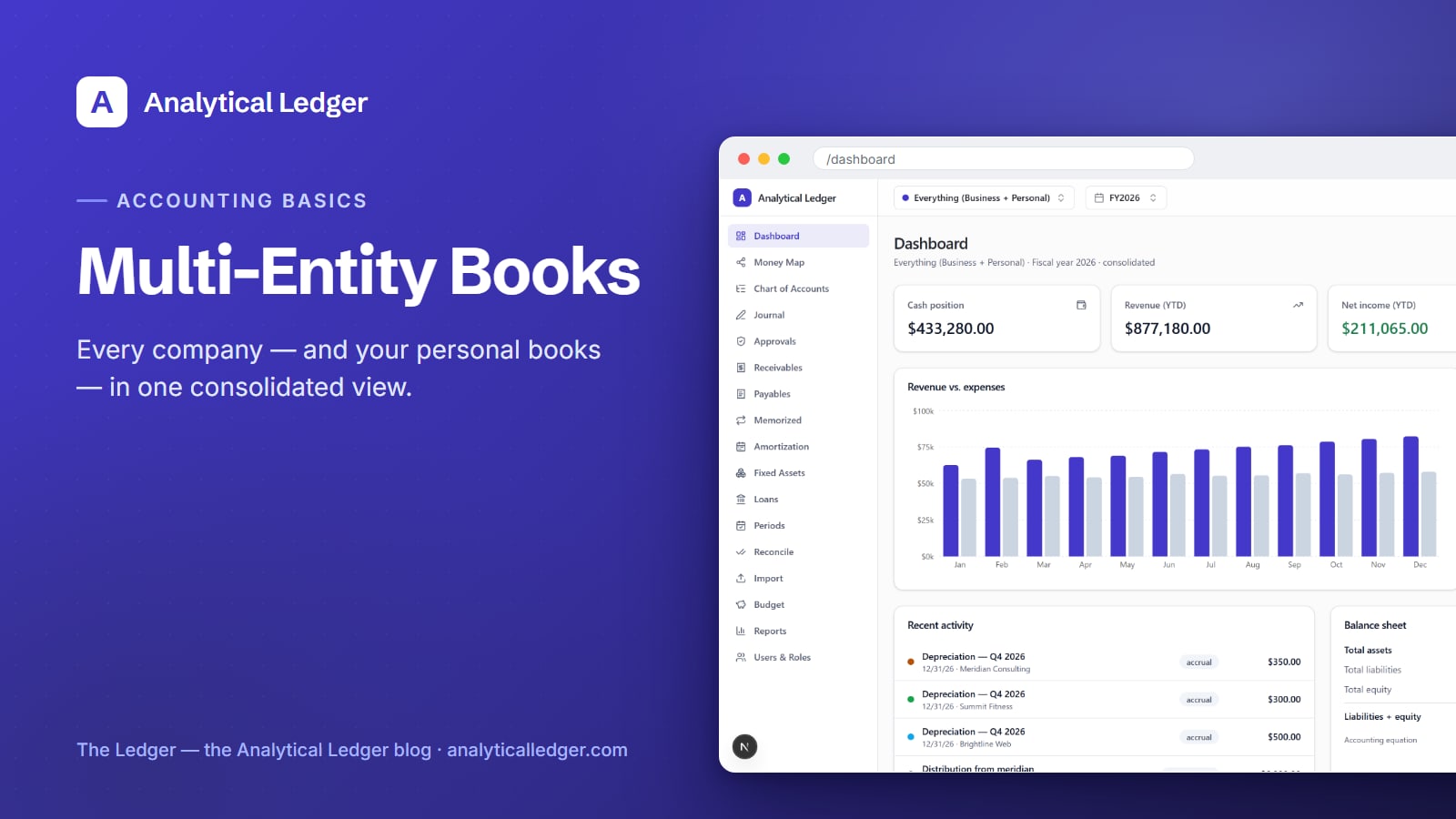
Your view is simply the entity-switcher selection. Flip it to a single entity to work on one business's books; flip it to a consolidation group to read the combined picture. The dashboard and every report redraw to match the view, so the same screens serve one company or the whole group without any per-entity setup.
Because posting is gated by monthly periods — open, closed, or locked — each entity closes on its own schedule. You can lock last month on one business while another is still open, and the group view respects each entity's state.
5. Read the whole flow on the Money Map
The Money Map traces how money moves through the entire group in one picture — revenue earned in the operating companies flowing up through the holding company and out to Personal. Instead of imagining the structure from a list of accounts, you see it: which entity earns, which entity holds, and where the distributions land.

It's the clearest answer to "where did the money actually go" across every business you run. The Money Map guide walks through reading it in detail.
We run our own group of companies this way
We run our own group of companies — and our personal finances — on Analytical Ledger, daily, in production. The demo group you see in the screenshots is fictional, but the model behind it is the one we use ourselves: separate books per entity, consolidation groups that roll them up, and distributions that net out so nothing is double-counted. The multi-entity design exists because we needed it first.
What people get wrong about multi-entity accounting
The common mistake is treating "consolidated" as a copy-paste job — dumping every transaction from every company into one big ledger and calling it the group. That destroys the separate records you need for each tax return and quietly double-counts every dollar you moved between businesses.
Real consolidation keeps each entity's books intact and nets out the intercompany flows only in the combined report. Your LLC still files as an LLC; your consulting practice still stands alone. The group view is a lens over separate books, not a replacement for them — which is exactly why distributions are tagged and eliminated instead of deleted.
The other misconception is that personal finances don't belong in the same tool. For an owner, the business and the household are one cash reality — the distribution that leaves the company lands in your personal account. Keeping personal finances as a first-class entity is what makes the whole picture true.
Frequently Asked Questions
Do I have to pay per company for multiple entities?
No. Analytical Ledger has no per-entity or per-company fee — you run as many entities as you need at no cost. Mainstream tools charge for each company file and still leave you assembling the group picture by hand. Here every entity lives in one place, free, with consolidation built in.
How do I stop transfers between my businesses from being double-counted?
Record the movement as a distribution — two matched, balanced entries tagged as intercompany, one in each entity. Because both sides carry the tag, any consolidated report eliminates them automatically. The money stays real on each entity's own books but cancels at the group level, so you never count your own dollars twice.
Can I include my personal finances with my business books?
Yes. Personal finances are a first-class entity in Analytical Ledger, not an afterthought. You keep a full set of books for your household alongside each business, decide whether it joins a consolidation group, and see the owner distributions that flow from your companies into your personal accounts on the Money Map.
What is the difference between an entity and a consolidation group?
An entity is one complete set of books — a single business or your personal finances — that balances on its own. A consolidation group is a named roll-up of several entities whose combined reports eliminate the money moved between them. Entities are the pieces; a group is the lens that reads them together.
Can I start with one business and add more later?
Yes. Nothing forces you to set up every entity at once. Start with one set of books, get it caught up and reconciled, then add a second entity when a new LLC or side business calls for it. Group them whenever you want a consolidated view — the structure grows with you.
See the whole picture in one place
If you're running more than one set of books today, the fix isn't another subscription — it's every entity in one place, netted out correctly, and yours to keep. Start with the tour of the modules to see multi-entity in context, or tell us about your setup and we'll point you to the right starting entity.
About Analytical Solutions. We build Analytical Ledger — free, correct-to-the-cent, double-entry accounting that keeps every entity, including your personal finances, in one place. We run our own group of companies on it in production. More about us.